
Introduction
How to write a cover letter for Middle East jobs in 2026 is no longer a side topic; it often decides who receives interview calls in Dubai, Riyadh, and Doha. Recruiters scan hundreds of AI-written letters that sound nearly identical, so weak ones disappear within seconds.
The risk grows when a cover letter repeats the CV, ignores Gulf culture, or hides relocation plans. Many strong candidates lose out before anyone even opens their LinkedIn profile.
There is a better way. When I learn how to write a cover letter for Middle East jobs in 2026 with clear structure, local research, and real numbers, my application sounds human again. In this guide, we walk through what Gulf employers expect, how to format the letter, how to adapt it for each country, and what to avoid so that one page becomes a calm but persuasive argument to hire me.
Key Takeaways
Before I start writing, I want to know what I will gain from a guide. These points show how this article helps me approach cover letters for UAE, Saudi Arabia, Qatar, Oman, Jordan, and Egypt.
- A modern Gulf cover letter still matters because it shows how I think, write, and prepare. Recruiters at Emirates in Dubai or Saudi Aramco in Dhahran often read it before the CV. When the letter is specific and researched, it separates me from many AI-generated attempts.
- Middle East employers prefer clear results and a formal tone over clever wording. Banks in DIFC, energy firms like ADNOC, and hotels managed by Marriott in Doha look for proof of value, not buzzwords. They expect numbers, regional awareness, and reference to their own projects.
- Format is not decoration; it is a reading guide for busy HR staff. When my header, greeting, body, and closing follow a simple business letter layout, talent teams at companies such as Qatar Airways or Etihad Airways can scan my letter in seconds, which raises my chances of a call.
- Each Gulf country has its own hiring habits and national goals. Saudi Vision 2030, Qatar National Vision 2030, and the UAE Strategy for the Future shape which skills matter. If I show that I understand those programs, my cover letter feels grounded in the region.
- Repeated mistakes destroy strong profiles quickly. At Smart Hiring Gulf, we see good engineers, nurses, and sales managers blocked by generic openings, copied templates, and overused AI phrases. Once I fix these issues, my profile and my cover letter finally work together.
Why Your Cover Letter Still Matters In The 2026 Gulf Job Market

A cover letter still matters in the 2026 Gulf job market because it is the one-page test of my intent, research, and communication. It gives hiring teams across the United Arab Emirates, Saudi Arabia, and Qatar a quick way to sort serious applicants from mass senders.
Companies such as Emaar in Dubai, QatarEnergy in Doha, and stc in Riyadh often receive hundreds of CVs for roles in finance, construction, and technology. According to ResumeGo, applicants with a custom cover letter receive roughly 50% more interviews than those who send only a resume. That pattern fits what regional recruiters report on platforms like Smart Hiring Gulf, GulfTalent, and Bayt.
In 2026, many applicants already use tools from Microsoft or Google to polish their CV. Keywords for SAP, Oracle, or IFRS appear in almost every profile. When CVs look similar, a personal, targeted letter for the Middle East becomes an easy advantage that many ignore.
A clear letter also answers doubts that Gulf employers rarely say out loud. HR managers in Abu Dhabi or Jeddah want to know if I will really relocate, respect local culture, and stay longer than one short contract. When I explain my reasons, mention earlier time in Dubai or Muscat, and show awareness of local norms, my application feels less risky.
“The cover letter is where we check if a candidate has actually read the job description,” says a senior recruiter who hires across the UAE and Saudi Arabia through Smart Hiring Gulf.
At Smart Hiring Gulf, we see that employers in oil and gas, aviation, and hospitality often ask to see cover letters first. That single page tells them who did the homework and who clicked Apply All.
What Does A Strong Cover Letter For Gulf Employers Actually Look Like?

A strong cover letter for Gulf employers in 2026 shows clear fit, measured results, and real research on the company and country. When I learn how to write a cover letter for Middle East jobs in 2026 with these three parts, I give recruiters a reason to call me, not the next person.
A simple way to build that strength is to focus on three pillars:
- Relevant Experience, Not Duties
If I apply to DP World in Jebel Ali, I highlight logistics projects, port systems, or supply chain tools I used, such as SAP TM or Oracle Transportation Management. For a banking role in Qatar National Bank, I talk about Basel rules, risk reports, or cross‑border clients I handled. Each example points directly at the job description instead of repeating my CV. - Numbers That Show Value
Instead of saying I am a hard worker, I share numbers for revenue, cost, time, or quality. For example, I might write that I improved on‑time delivery by 18% on a Riyadh construction project, or raised occupancy by 12% in a Cairo hotel managed by Accor. Research from McKinsey shows that Gulf employers focus strongly on measurable performance, and my letter should reflect that habit. - Company And Country Research
If I apply to a fintech role in Abu Dhabi Global Market, I refer to ADGM rules, a recent license the firm received, or a product launch they announced in the Financial Times. If I write to a tourism project under Saudi Vision 2030, I mention the specific giga project, such as NEOM or Red Sea Global. This kind of detail cannot come from a generic template.
When I follow this pattern, my cover letter stops being a summary of my CV. It becomes my argument about why I, with my background and my reasons, fit this company in this Gulf city at this moment.
The Right Format And Structure For Middle East Applications
The right format for Middle East cover letters follows a clean business letter style that respects time and hierarchy. Recruiters in Dubai, Doha, and Muscat move fast, so I help them by making the page easy to scan. Research from Ladders found that recruiters often spend only a few seconds on an initial scan of each document — a dynamic further confirmed by technology-mediated interviews: meta-analyses on interview ratings showing how first impressions form rapidly in modern hiring — so clarity matters.
I keep the structure simple:
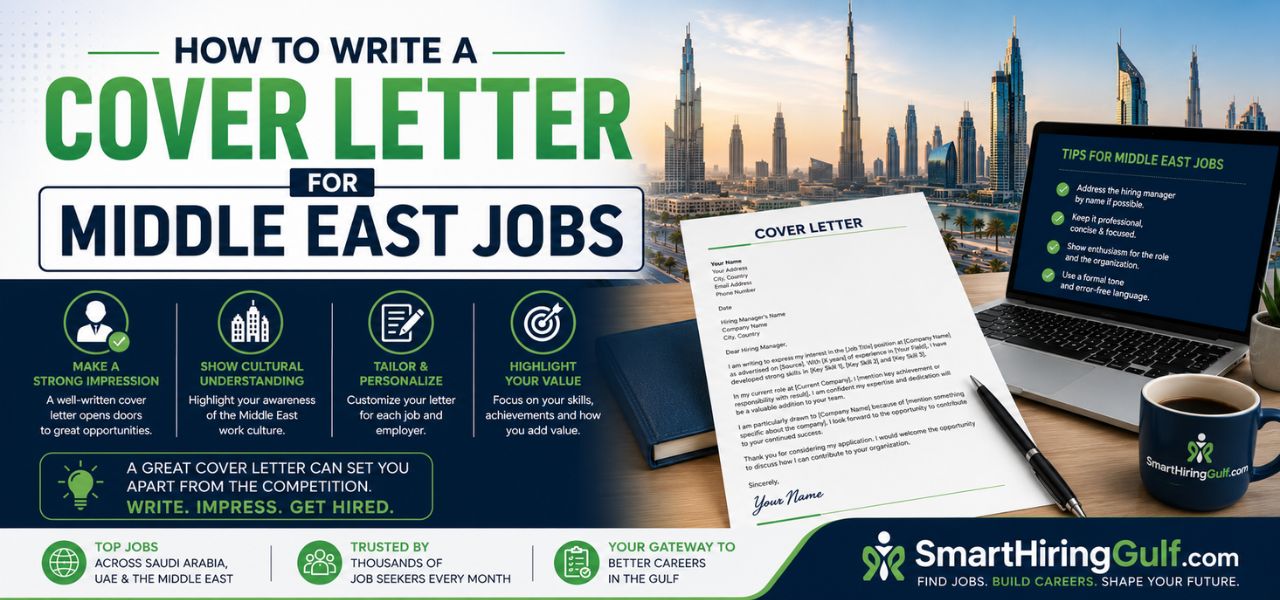
- Header – I include the date, my full name, mobile number with country code, professional email, and current city. I also add the company name, department, and city for the employer, such as Emirates Group in Dubai or Ooredoo in Doha. This keeps my letter usable even if it is stored away from my CV.
- Salutation – I use a real name whenever I can find it on LinkedIn or the company website. I write Dear Mr Al‑Rashidi or Dear Ms Hassan, not a vague greeting. A named greeting signals that I took time to find the right person in HR or the hiring team.
- Opening Paragraph – I state the exact role and where I saw it, such as the Smart Hiring Gulf portal or a LinkedIn post. In the same short paragraph, I add one strong reason I fit the role, often a single achievement tied to the main skill in the ad. This gives the reader a quick hook.
- Body Paragraphs – I cover two or three results that matter for this role and this market. I match them with skills from the posting, such as IFRS reporting for KPMG in Riyadh or HVAC project delivery for an Abu Dhabi contractor. If I apply from outside the region, I use one paragraph to confirm my readiness and timeline for relocation.
- Closing Paragraph – I thank the reader, repeat my interest in that exact company, and point to my CV or Smart Hiring Gulf profile. I mention that I am available for an online interview and give clear contact options. The sign‑off uses Yours sincerely with my full name and fits easily on one page.
Tip: Print your letter or view it on a mobile screen and check if each paragraph can be understood at a glance. If I cannot scan my own writing fast, HR will struggle as well.
How To Adapt Your Cover Letter For Specific Gulf Countries

Learning how to write a cover letter for Middle East jobs in 2026 also means adjusting it for each country. The UAE, Saudi Arabia, Qatar, Oman, Jordan, and Egypt share some hiring habits, yet each market has its own tone, programs, and priorities.
For the United Arab Emirates, I usually stress international teamwork and speed. Dubai and Abu Dhabi companies such as Emirates, Etisalat by e&, and Mubadala work with many nationalities and tight deadlines. Mentioning experience in free zones like Dubai International Financial Centre or Jebel Ali Free Zone shows that I understand how business structures there operate. According to the World Bank, expatriates form a large part of the UAE workforce, so employers look closely at how newcomers adjust.
For Saudi Arabia, Vision 2030 shapes many roles. When I write to firms like Saudi Aramco, the Ministry of Tourism, or stc, I link my experience to diversification, sustainability, or large infrastructure programs. I also show basic awareness of Saudization rules, which aim to raise the share of Saudi nationals in private sector jobs. Research from PwC Middle East notes that national programs strongly influence hiring across the kingdom.
Qatar values large project experience, especially around infrastructure, aviation, and education. If I apply to Qatar Airways, Qatar Foundation, or companies in Lusail, I stress work on stadium builds, rail systems, or campus projects. For Oman, Jordan, and Egypt, my tone stays slightly more formal, and I highlight long‑term commitment, stable career steps, and respect for local culture in Muscat, Amman, or Cairo.
A simple approach I follow when I adjust a letter for each Gulf market is:
- I research current national plans on official portals, such as Vision 2030, Oman Vision 2040, or Egypt Vision 2030. Then I write one short sentence in my letter that shows how my skills, such as renewable energy or tourism marketing, support those plans.
- I match my examples to the sector focus of that country. For Abu Dhabi clean energy roles with Masdar, I focus on solar or wind work. For hospitality clusters in Sharm El Sheikh or Salalah, I write about guest satisfaction scores and tour operator links. Each example shows that I understand the local market, not only the generic job title.
- I address relocation and legal topics clearly. If I already live in Doha on a valid work visa, I mention that. If I live in Mumbai or Manila and plan to move within one month of offer, I say so. Recruiters using Smart Hiring Gulf often tell us that this simple clarity saves them many hours.
Common Cover Letter Mistakes That Cost You Gulf Job Interviews

Common cover letter mistakes cost many Gulf applicants interviews even when their skills fit the role. When I focus on how to write a cover letter for Middle East jobs in 2026, I first try to stop these errors before I chase fine details.
At Smart Hiring Gulf, we review thousands of applications for employers across Dubai, Riyadh, and Doha. A study by Hays reported that more than half of employers reject candidates because their applications feel generic or careless. Our daily review of letters for companies like Emirates NBD, QatarEnergy, and Ooredoo confirms the same pattern.
Here are mistakes I avoid:
- Rewriting the CV instead of adding context. When I repeat job titles and duty lists, HR at HSBC in Dubai or Banque Misr in Cairo learns nothing new about my fit. The letter should explain why those roles prepare me for this company now, not copy bullet points from the resume.
- Using weak, generic openings. If I start with I am writing to apply for the position of without any fresh detail, recruiters lose interest before the first full paragraph. A better start links the role to one sharp result, such as growing B2B sales by 30% for a previous client in Jeddah or Sharjah.
- Ignoring company names or getting them wrong. Spelling Abu Dhabi Commercial Bank, Qatar Museums, or Oman Air incorrectly tells HR that I do not read my own work. When I send the same wording to ten employers, logos may change but mistakes often stay, and that damages trust.
- Relying on AI text without editing. Phrases like I sit at the intersection of finance and technology or I would be thrilled to bring my skill set to your dynamic team now appear in thousands of letters. Recruiters at firms such as Deloitte Middle East and Kearney notice these lines instantly. I use AI to clean grammar, then I delete every sentence that could belong to any other person.
- Skipping contact details or relocation facts. Some HR teams store the letter separate from the CV inside systems from SAP or Workday. If my mobile and email are missing, or I stay silent about my move from Lahore or Nairobi, I create extra work for them. Many will simply move on to the next profile.
When I fix these issues, my letter finally supports my Smart Hiring Gulf profile instead of working against it.
The Bottom Line

The bottom line for anyone asking how to write a cover letter for Middle East jobs in 2026 is simple: a short, researched, and country‑aware letter is still one of the strongest tools I have in the Gulf hiring process.
Recent insights from LinkedIn show that communication and professionalism stay among the top skills employers screen for across MENA. My cover letter is the place where those skills appear in real form. With one clear page, I show that I understand Vision 2030, DIFC rules, or local client needs, and that I can express this in plain English.
When I connect that letter with an ATS‑friendly CV and a complete Smart Hiring Gulf profile, my chances in the UAE, Saudi Arabia, Qatar, Oman, Jordan, and Egypt rise sharply. I stop looking like one more AI‑shaped document and start reading like a person that a hiring manager wants to meet.
Frequently Asked Questions
Many job seekers share similar doubts once they start applying through Smart Hiring Gulf or other Gulf‑focused platforms. These short answers give me quick guidance while I adjust my own cover letter.
Question 1: Should I submit a cover letter if the Gulf job posting does not specifically ask for one?
I should usually send a cover letter, even if the posting is silent. The exception is when the employer clearly bans extra documents in the portal. For most roles in Dubai, Riyadh, or Doha, a focused one‑page letter helps me stand out.
Question 2: How long should a cover letter be for Middle East job applications?
One page is the standard length for Gulf employers. Recruiters at firms like Emirates, Qatar Airways, and Ooredoo process many files each day, so shorter pages show respect for their time. I keep my points tight and leave deeper detail for the interview.
Question 3: Is it acceptable to use AI to write my cover letter for Gulf jobs?
Yes, it is fine to use AI tools from providers such as Microsoft or Google as a helper. I let them suggest structure and check grammar, then I rewrite until every sentence sounds like me. I remove generic phrases and add company research that AI cannot guess.
Question 4: How do I address relocation in my cover letter for a UAE or Saudi Arabia job?
I mention relocation in the main body, usually the second or third paragraph. I state that I am ready to move, give an honest timeline, and mention any past stay in Dubai, Abu Dhabi, Jeddah, or Riyadh. This removes doubt and helps HR move faster.
Question 5: What is the biggest difference between writing a cover letter for a Gulf employer versus a Western employer?
Gulf employers place stronger weight on formal tone, clear hierarchy, and reference to national goals like Vision 2030 or Expo‑related growth. Many Western firms accept more casual or creative text. In the Middle East, I keep language respectful, stress results, and show local awareness.