
Introduction
The highest paying jobs in Saudi Arabia and UAE in 2026 offer record salaries, yet many professionals still feel unsure about how to read those figures. Salary tables look attractive, but the fine print often hides bigger truths. A rushed decision can lock someone into a package that looks strong on paper but feels disappointing later.
Recent salary guides from Hays show sharp pay rises across the Gulf, while Saudi Vision 2030 mega projects like NEOM and the Red Sea Project pull in global talent. At the same time, the UAE keeps Dubai and Abu Dhabi at the center of finance, technology, and real estate in the region. This mix creates huge chances, but also tough competition for the best roles.
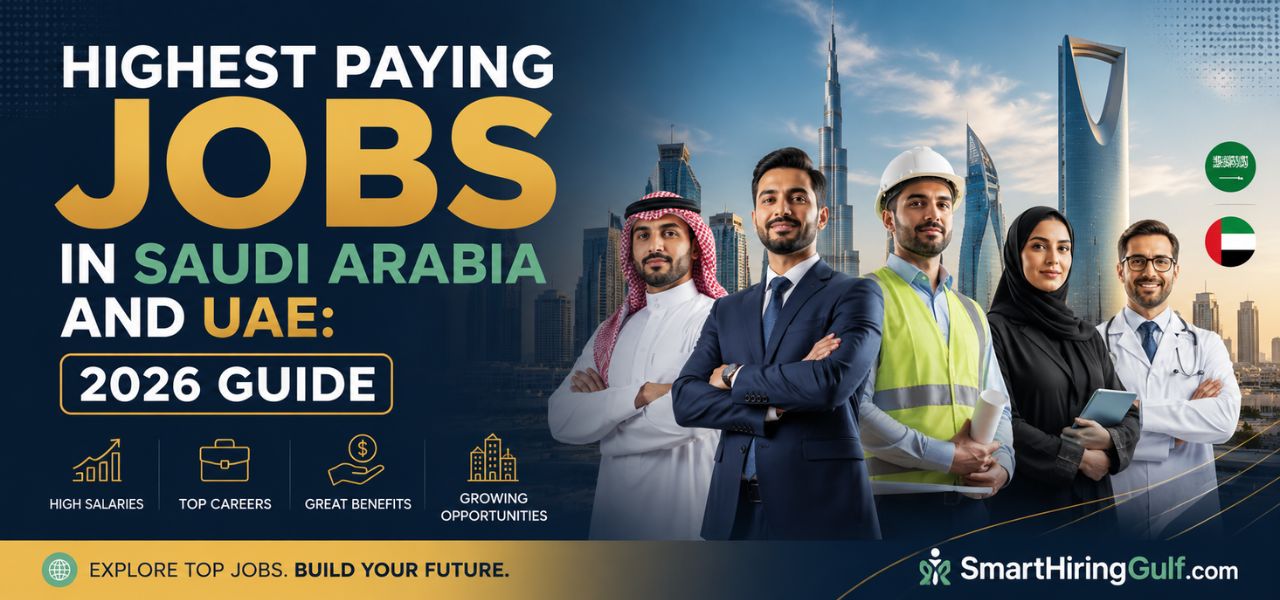
In this Highest Paying Jobs in Saudi Arabia and UAE (2026 Guide), I explain which roles sit at the top of the pay scale, how total compensation works, and which skills matter most. I also share how our team at Smart Hiring Gulf helps serious candidates connect with those roles faster. Keep reading to see where the real money is, and how to position yourself for it.
“The best way to predict the future is to create it.” — Peter Drucker
For Gulf careers, that means choosing the right role, in the right country, with the right package.
Key Takeaways
- Gulf salaries rise fast. Hays data shows broad pay growth, and employers plan more hiring. Skilled candidates gain bargaining power.
- Saudi Arabia and the UAE reward different profiles. Vision 2030 shapes Saudi demand, while Dubai and Abu Dhabi favor finance and tech. Your choice of country shapes your long‑term career path.
- Total compensation beats base salary every time. Housing, flights, schooling, and bonuses change the real number. Smart professionals always compare full offers.
- Skills in AI, cybersecurity, finance, and PMP‑level project management attract premium pay. Shortage areas give more room to negotiate.
- Smart Hiring Gulf focuses on GCC roles. Structured candidate profiles speak directly to regional recruiters, which helps serious applicants stand out.
Why The Gulf Job Market Offers The Highest Paying Opportunities In 2026

The Gulf job market in 2026 offers some of the highest paying roles worldwide because demand outstrips supply in many skill areas. Saudi Arabia and the UAE both push large reform plans that fuel hiring across finance, technology, engineering, and healthcare. This growth gives strong bargaining power to well prepared candidates.
According to recent research from Hays, around 69 percent of employers in Saudi Arabia expect salary increases, while roughly 80 percent plan to add more staff. Hays also reports that over 90 percent of Saudi organizations face skills shortages, especially in technology and technical roles. When almost every company struggles to fill roles, pay levels rise across Riyadh, Jeddah, and the new NEOM zones.
Vision 2030 adds another layer. Projects such as NEOM, Red Sea Project, and Diriyah attract billions of dollars in investment, with support from groups like the Public Investment Fund and large global contractors. Research from the World Bank shows that Gulf economies that invest heavily in infrastructure often see strong private job growth for several years. That chain effect lifts salaries not only for engineers, but also for finance, legal, and HR leaders.
On the UAE side, Dubai and Abu Dhabi keep pulling in banks, fintech start ups, and multinational headquarters. Non‑oil sectors now form most of UAE GDP according to the UAE Ministry of Economy, while the country still keeps zero personal income tax. For many professionals from the United States, India, Pakistan, or Europe, this tax benefit means net pay in the Gulf can beat home markets even when base salaries look similar.
“Talent is the multiplier. The more energy and attention you invest in it, the greater the yield.” — Marcus Buckingham
For professionals with scarce skills, the current Gulf hiring cycle can multiply earning power much faster than many other regions.
Highest Paying Jobs In Saudi Arabia In 2026

Highest paying jobs in Saudi Arabia in 2026 sit mainly in senior finance, technology, mega project delivery, healthcare, and legal leadership. These roles link directly to Vision 2030 spending and the rapid reform of sectors like health and tourism. Salary ranges below are monthly, in Saudi riyals (SAR), and reflect data from guides like Michael Page and Hays.
- Chief Financial Officers (CFOs) and senior finance leaders earn among the strongest packages, usually between SAR 60,000 and 120,000 each month. Recent Saudi and GCC guides from Hays and Michael Page show CFOs in Riyadh now paid about 20 to 35 percent more than peers in Dubai for similar scope. Vision 2030 mega projects and new regional headquarters need experts who can manage large budgets, treasury risk, and complex funding structures. Many offers also add housing, schooling, and long‑term incentives on top of base pay, which pushes real earnings even higher.
- Technology and AI leaders, such as Chief Technology Officers, cybersecurity heads, and data directors, also sit near the top of the scale. CTOs often earn SAR 80,000 to 130,000, while cybersecurity managers and AI or machine learning specialists can see ranges from SAR 25,000 to 80,000. The Michael Page Saudi Arabia guide highlights large‑scale IT change and cybersecurity as some of the scarcest skill sets in the Kingdom. That shortage raises pay levels in cities like Riyadh, Dammam, and Jeddah.
- Project directors on giga projects like NEOM, Qiddiya, and Red Sea Project usually earn between SAR 60,000 and 100,000. Senior project managers with PMP certificates and strong MEP backgrounds often land in the SAR 25,000 to 50,000 band. These roles manage huge civil, mechanical, and electrical packages linked to global contractors like Bechtel and Jacobs. Project delays cost billions, so experienced PMP leaders who can keep schedules and budgets on track are paid very well.
- Healthcare consultants, hospital CEOs, and medical directors also see strong compensation. Many hospital leaders in Saudi Arabia sit in the SAR 60,000 to 100,000 range, while consultant doctors and specialist surgeons often earn SAR 35,000 to 70,000. Reports cited by the Saudi Ministry of Health show continuous investment in private and public health capacity, which keeps demand for top clinicians high, especially in cardiology, oncology, and critical care.
- General Counsel and senior legal or compliance leaders round out the list. Chief legal officers and heads of compliance tend to earn SAR 60,000 to 110,000 each month. As new labor rules, foreign investment laws, and PPP models expand across Vision 2030 projects, boards in Riyadh and NEOM rely on strong in‑house legal direction. That reliance turns into premium pay for advisers with cross‑border, project finance, and regulatory experience.
For senior professionals aiming at Saudi Arabia’s highest paying jobs, proven success in the region plus international exposure often moves offers into the top end of these ranges.
Highest Paying Jobs In The UAE In 2026

Highest paying jobs in the UAE in 2026 center on banking, investment roles, technology leadership, real estate development, and regional sales heads. Dubai International Financial Centre (DIFC) and Abu Dhabi Global Market (ADGM) host many of these positions. The zero income tax policy then lifts the real value of every dirham earned.
- Investment banking and private equity roles in DIFC and ADGM often pay between AED 80,000 and 150,000 each month at director or managing director level. These packages usually mix base salary with performance‑based bonuses that can match or pass the base. Global groups like HSBC, Goldman Sachs, and Mubadala Capital use Dubai and Abu Dhabi to cover the wider MENA region. That regional span supports higher pay for successful deal makers who can close cross‑border transactions.
- Chief AI officers, cybersecurity directors, and senior data leaders have quickly moved into the top tier of pay. AI leaders in major groups or government‑linked entities often earn AED 80,000 to 140,000, while cybersecurity directors and data science heads usually sit between AED 30,000 and 90,000. A recent report from PwC Middle East notes that AI could add hundreds of billions of dollars to GCC GDP. UAE leaders want that gain, so they pay strongly for the talent that can design, build, and run AI programs.
- Real estate development directors and construction project directors still benefit from Dubai’s constant building cycle. These leaders often earn AED 45,000 to 90,000, with higher numbers for flagship towers or resort projects led by groups such as Emaar and Aldar. Even with cycles in property demand, Dubai and Abu Dhabi continue to approve large hospitality, residential, and logistics projects that need experienced oversight from senior development and project professionals.
- Senior sales and commercial leaders who manage MENA for global brands also sit high on the pay ladder. A regional sales director based in Dubai for a technology, pharma, or FMCG company can often earn AED 50,000 to 90,000. These roles tie pay directly to revenue growth across Saudi Arabia, Qatar, Egypt, and the rest of the Gulf. Strong performance brings large bonuses and, in some cases, stock or long‑term incentive schemes.
The UAE’s zero personal income tax, confirmed by the UAE Federal Tax Authority, makes these salaries even more attractive compared with similar roles in London or New York. A monthly package of AED 90,000 in Dubai often means more net pay than a higher nominal salary in a high tax market.
What Is Total Compensation And Why It Matters More Than Base Salary

Total compensation in the Gulf means the full value of a job offer, not just the monthly salary. It includes housing, flights, bonuses, schooling, and end‑of‑service pay. Professionals who focus only on base figures often accept weaker offers without realizing it.
Typical Gulf packages for mid and senior roles include several parts:
- Housing allowance has a huge effect on real income. In Saudi Arabia and the UAE, many companies add 20 to 30 percent of base salary for housing or provide a villa or apartment. Rent in areas like Riyadh’s Diplomatic Quarter or Dubai Marina can absorb a large share of take‑home pay. A strong housing offer can protect savings and family comfort, while a weak one can quietly drain most of your cash.
- Annual air tickets keep family ties easier to manage. Many offers include one or two return tickets each year for the employee, and often for dependents. These flights back to India, Pakistan, the United Kingdom, or Egypt can cost several thousand dollars. When the company covers that amount, the package value jumps without raising base pay.
- Schooling support matters a lot for mid‑career professionals with children. International school fees in Dubai or Riyadh can reach levels similar to private schools in Europe, as noted by surveys from UNESCO. Some employers cover full fees, while others offer a yearly allowance. Without this part, a high salary can vanish into tuition bills.
- End‑of‑service gratuity, medical insurance, and performance bonuses also add clear value. Gratuity rules in both Saudi Arabia and the UAE grant a lump sum based on years of service. Medical cover often applies to the employee and family, cutting health costs. Annual bonuses in finance, technology, and project roles can sit between 10 and 30 percent of base pay, and in some cases more.
Tip: When you compare two offers, put every allowance into a simple spreadsheet and convert it to an annual cash figure. Only then compare packages side by side.
Consider a simple example. A CFO role in Riyadh at SAR 90,000 per month plus 30 percent housing, schooling, flights, medical cover, and a 25 percent annual bonus can beat an AED 70,000 Dubai offer with only basic benefits. To judge offers wisely, I always advise friends, clients, and Smart Hiring Gulf candidates to build a full spreadsheet of every allowance, not just look at the headline number.
How To Land A High-Paying Gulf Role With Smart Hiring Gulf

Landing a high paying role in Saudi Arabia or the UAE in 2026 needs more than a strong CV. It needs clear research, targeted skill upgrades, and a profile that matches how Gulf recruiters search. This is exactly where our work at Smart Hiring Gulf fits in.
I usually guide professionals through three connected steps:
- Research salary benchmarks with care. Use the Hays GCC Salary Guide, the Michael Page Saudi Arabia Salary Guide, LinkedIn, and Glassdoor to see current bands for your role across Riyadh, Dubai, Doha, and Muscat. Pay close attention to how salaries change by sector, company size, and country. This research gives a realistic view of your value before the first interview and helps you avoid accepting an offer that underprices your skills.
- Build skills in high demand areas instead of general training — findings from the 2025 Report on Nonemployer Firms highlight that hiring plans are increasingly tied to specialized skill availability, underscoring the value of targeted professional development. For example, a project manager with a PMP certificate plus experience on large infrastructure work in NEOM or Abu Dhabi will earn more than one without those signals. In finance, CFA, ACCA, or CPA status still carries weight across Gulf banks and family groups. In technology, proof of hands‑on work with cloud tools like AWS and Azure helps more than broad IT labels. Focused development in one or two shortage skills can move you into higher pay brackets quickly.
- Present a strong, region‑ready profile through Smart Hiring Gulf. Our platform focuses on GCC employers, not the global mass market. When you create a structured profile and attach an ATS‑friendly resume and cover letter, recruiters from Saudi Arabia, UAE, Qatar, and Oman can find you faster. We also align resume content with what hiring managers in Riyadh, Dubai, and Jeddah expect to see, which increases short‑list chances.
“The best investment you can make is in yourself.” — Warren Buffett
Using that idea, Smart Hiring Gulf helps you present that investment clearly: your skills, projects, and regional experience in a format Gulf recruiters can work with quickly.
Because Smart Hiring Gulf only focuses on the Gulf region, we save both time and effort for serious job seekers. Instead of sending applications across random global boards, you place your profile directly in front of companies that already plan to hire in Saudi Arabia and the UAE during this busy 2026 cycle.
The Bottom Line
Gulf markets in 2026 offer some of the strongest earning chances for skilled professionals anywhere. Saudi Vision 2030 mega projects and the UAE’s push into finance, AI, and tourism keep demand high for senior finance, tech, engineering, healthcare, and legal leaders, a trend further substantiated by the 2026 Report on Employer Firms which documents sustained employer hiring ambitions heading into the current cycle. At the same time, total compensation, not just base salary, decides whether an offer truly builds long‑term wealth.
Professionals who understand this picture, invest in shortage skills, and present clear profiles will stand out. If you want to move into the highest paying roles in Saudi Arabia or the UAE, now is an excellent time to act. Create or update your profile on Smart Hiring Gulf, and let our Gulf‑focused platform link you with employers who are already hiring for the region’s top packages.
Frequently Asked Questions
Question: What is the highest paying job in Saudi Arabia in 2026?
The highest paying roles in Saudi Arabia in 2026 are usually CFO and senior finance leadership positions, which often sit between SAR 60,000 and 120,000 each month, supported by Vision 2030 mega project demand.
Question: Are salaries in Saudi Arabia higher than in the UAE?
At senior executive level, Saudi Arabia often pays more, with many CFO roles in Riyadh earning 20 to 35 percent more than Dubai equivalents. The UAE still offers strong total packages, plus a mature lifestyle and business environment.
Question: Do I need to pay income tax on my salary in the UAE or Saudi Arabia?
No, neither Saudi Arabia nor the UAE currently charges personal income tax on salaries, so gross pay and net pay are usually the same, which creates a clear edge over high tax markets like the United States or the United Kingdom.
Question: Which skills are most in demand for high-paying Gulf jobs in 2026?
AI and machine learning, cybersecurity, cloud infrastructure, PMP‑level project management, and senior finance credentials such as CFA, ACCA, or CPA rank near the top. Recent Hays data shows more than 90 percent of Saudi employers see shortages in these areas.
Question: How does Smart Hiring Gulf help me find a high-paying job in the Gulf?
Smart Hiring Gulf is a Gulf‑focused talent platform that brings your structured profile in front of Saudi, UAE, and wider GCC employers. By matching ATS‑ready resumes with region‑specific roles, it helps serious professionals connect with high paying openings faster.