

The global job market is undergoing a massive shift, and at the center of this transformation is the Gulf Cooperation Council (GCC) region. With rapid economic diversification and ongoing infrastructure projects across the United Arab Emirates (UAE), Saudi Arabia, Qatar, Kuwait, Oman, and Bahrain, the Gulf has become a major hub for global professionals. Whether you are aiming to join a multinational in Dubai’s financial hub, step into a high-growth leadership role in Riyadh, or explore executive opportunities in Doha, Muscat, Manama, or Kuwait City, the region offers substantial career opportunities.
However, many highly qualified international candidates encounter a frustrating roadblock: they apply to hundreds of roles, constantly tweaking their files and polishing their experience, only to be met with absolute silence.
The harsh truth is that the standard CV that successfully secured you interviews in London, New York, or Mumbai may not be as effective in the GCC. The problem is not your experience; it is how your experience is presented. In the competitive Gulf recruitment landscape, where competition for roles can be highly active, the sources recommend tailoring your resume to align with regional expectations.
This complete guide will break down the exact, evidence-based strategy to build a ‘Gulf-Ready CV’ that is easier for applicant tracking systems to process and presents your experience clearly to human recruiters, helping to position you as a competitive candidate for GCC jobs.
1. Shift Your Perspective: The “Safe Pair of Hands” Concept
Before writing a single word on your resume, you must understand a fundamental truth of recruiting: hiring managers are under immense pressure. They are managing massive regional operations, racing against tight project deadlines, and trying to avoid costly hiring mistakes.
Contrary to popular belief, they are not necessarily looking for the absolute smartest “genius” or a highly disruptive visionary who might upend their team. Instead, what they want most is a “safe pair of hands.”
A safe pair of hands is a candidate who:
- Demonstrates they have successfully performed the exact job duties before.
- Shows they can step in and solve immediate business problems from day one.
- Conveys reliability, low friction, and structured execution.
- Can step into the role with less need for extensive initial guidance.
To project this “safe” profile, your CV must transition from a simple historical record of your employment into a highly curated, active business solution. Every bullet point, section header, and highlight must scream: “I have solved your exact problems before, and I will do it again for your organization.”
2. The Visual vs. ATS Paradox: The Dual-Format Strategy
If you search for resume advice online, you will find a glaring conflict. On one side, global recruitment influencers and career coaches urge you to avoid graphic-heavy templates. They warn that flashy designs, columns, charts, and progress bars confuse Applicant Tracking Systems (ATS), leading to parsing errors that get your resume filtered out before a human ever sees it.
On the other side, in the competitive Gulf market, visual presentation is often appreciated. Recruiting sources suggest that regional hiring managers value a polished professional brand, and a clear, well-formatted layout can make an application stand out.
How do you resolve this “Visual vs. ATS” paradox? The sources suggest a Dual-Format Strategy, where you adapt your format depending on the application channel you use.
Format A: The Text-Based CV (For Online Portals)
When submitting your application through online job boards or corporate career portals, the sources recommend using a clean, single-column, text-based document.
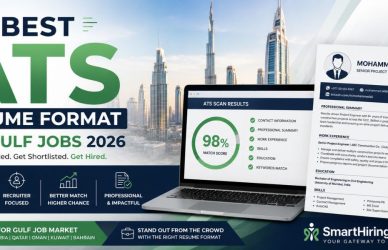
- ATS Compatibility: A single-column Microsoft Word or clean PDF format maximizes your Applicant Tracking System compatibility. It can improve compatibility, helping the parsing software extract your work history, skills, and contact details without scrambling the data.
- The Contact Info Hack: Always arrange your contact details vertically (one detail per line) rather than horizontally. ATS parsers typically read left-to-right and often fail to extract horizontal contact blocks properly, which can lead to database errors or your application being marked as missing contact details.
Format B: The Graphical CV (For Direct Outreach & Networking)
When you are networking directly, emailing regional headhunters, or sending your details for a referral, a Graphical CV can be an appropriate option to consider.
- Visual Storytelling: A Graphical CV is a visually compelling infographic resume designed specifically for human eyes. It transforms your career history into an eye-catching visual brand that blends professional layout with impactful visual storytelling.
- Cultural Alignment: Unlike generic online design templates that look childish or overly loud, a professionally crafted Graphical CV can use color palettes and typography aligned with the target industry and local cultural context. This can help create a polished and memorable professional presentation.
By keeping both formats ready in your job search toolkit, you satisfy the automated digital filters and make a memorable, high-end impression on human recruiters.
3. Achievement Architecture: How to Quantify Your Value
The most common mistake candidates make is writing their CV as a passive list of job responsibilities. If ten different project managers write that they were “responsible for managing operations” or “responsible for budget tracking,” they look completely identical. They become interchangeable commodities.
To stand out in the Gulf market, you must utilize “Achievement Architecture.” This means shifting from what you were responsible for to what you actually achieved. Each bullet point on your CV must lead with the business impact, prove that impact with a concrete metric, and then explain the context of how you did it.
To build these high-impact bullet points, you can use two highly effective, battle-tested formulas:
The Result + Metric + Context Formula
- Result: What changed or improved? (e.g., Cut operating costs, increased sales, accelerated delivery)
- Metric: What is the quantitative proof of your success? (e.g., 15%, $50,000, 3 months)
- Context: How did you achieve this, and what were the parameters? (e.g., by restructuring supplier logistics, by training a new team)
The XYZ Formula
- Accomplished [X], as measured by [Y], by doing [Z].
Real-World Examples: Before vs. After
To understand how to apply this architecture, let’s examine how to rewrite common, passive bullet points into powerful, active achievement statements:
- Bad (Passive Duty): “Handled various operational duties over five years.”
- Why it fails: It contains no metrics, no outcomes, and signals zero ownership. It leaves the recruiter wondering if you actually did a good job.
- Good (Achievement Architecture): “Cut operating costs by 15% in Q2 2024 by streamlining vendor contracts and consolidating regional supplier logistics.”
- Bad (Passive Duty): “Worked on a migration project for internal tools.”
- Why it fails: It sounds like you were just a passive observer on the team rather than a driver of success.
- Good (Achievement Architecture): “Led migration of internal tools to the cloud, cutting infrastructure costs by 25%.”
The Power of Metrics
Data from analyzed resume sets highlights the potential competitive advantage of quantifying your achievements. These findings show that a staggering 36% of resumes do not include a single measurable metric, while only 26% include five or more.
By placing a quantified achievement in the first bullet point of each job section, you can create a practical hook that encourages a busy recruiter to look closer at your experience.
4. Curating the Strategic “Signal”
Your CV is not a complete, exhaustive autobiography of your entire working life. It is a highly curated, strategic marketing signal designed to solve a recruiter’s immediate problem. If you try to include every minor task, project, and certification you have ever completed, your most significant accomplishments will get lost in a sea of text.
The Word Count Benchmark
A separate research finding, analyzing 125,343 resumes, identified 475 to 600 words as a common benchmark for resume length. In that specific analysis, resumes falling within this word count range saw double the interview callback rates compared to those that were outside those ranges. Keeping your resume concise helps you write with density, ensuring your most relevant achievements stand out.
The 5 to 7 Year Proving Ground
The sources provide practical guidance suggesting that candidates focus heavily on the last 5 to 7 years of their career. This period is often seen as your active “proving ground” to showcase your most relevant achievements and technical capabilities.
For roles older than 7 to 10 years, the sources recommend condensing your experience. You can limit older positions to a few bullet points, or list them under a simplified “Early Career History” section to show your career trajectory without cluttering the page.
Eliminate Cliches, Buzzwords, and Jargon
The analyzed resume data also revealed that 51% of resumes are cluttered with empty buzzwords and cliches. Terms like “team player,” “highly motivated,” or “detail-oriented” are generic fillers that can cause recruiters to lose interest. Instead of saying you are a team player, the sources recommend proving it by showing how you collaborated with a cross-functional team to achieve a specific business result.
Additionally, you must purge proprietary company jargon and internal product names from your CV. If you work for a company that uses an internal tool called “Delta-9” for database management, a recruiter in the open market won’t know what that means. Replace it with universal, industry-standard terms (e.g., “SQL database management system”) that any hiring manager can instantly comprehend.
5. Mitigate Risk: Addressing Career Gaps and Transitions Upfront
In recruiting, silence equals risk. When a recruiter scans a CV and encounters an unexplained career gap, a three-month tenure, or an abrupt industry pivot, they do not have the time to call you and ask for clarification. Instead, they will assume the worst-case scenario and move on to the next candidate.
For some roles, addressing potential concerns or transitions transparently on the page can be a useful way to manage perceived risk. The sources recommend addressing these details briefly and directly in your work history:
- For a Short Tenure: If a role only lasted a few months due to circumstances outside your control, you can state the context next to the dates.
- Example: “Operations Manager (March 2022 – May 2022) — Position impacted by regional departmental reorganization.”
- For a Career Gap: If you took time off for personal reasons, you can state it clearly to reduce ambiguity.
- Example: “Career Break (January 2023 – June 2023) — Managed family caregiving responsibilities; now fully available for relocation.”
By explaining these risks upfront, you eliminate the friction of doubt and demonstrate a level of professional maturity that recruiters deeply appreciate.
6. Localizing Your Strategy for the GCC Recruitment Ecosystem
Once you have built a dual-format, achievement-focused CV, you can adapt your approach to the regional recruitment ecosystem of the Middle East. In some sectors, applying to standard job boards and waiting for a response may not be sufficient on its own, and a proactive strategy can be helpful.
The Tailored Middle East Cover Letter
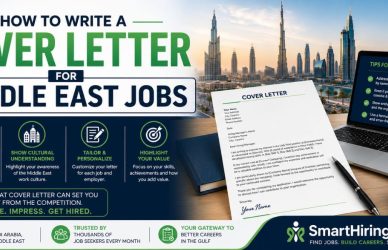
While some Western markets have moved away from cover letters, the sources recommend using them as a practical tool to communicate your plans and relevant qualifications. A personalized Middle East Cover Letter allows you to:
- Communicate your relocation interest and timeline if you are applying from abroad.
- Demonstrate genuine interest in the position and the regional market.
- Explain how your specific professional achievements fit the requirements of the role.
Proactive Outreach and Highlighting
In a crowded talent market, visibility is everything. To stand out, you can leverage specialized tools and services tailored to the GCC ecosystem:
- Portal Highlighting (Resume Brighter): For localized employer portals, using specialized visibility services like Resume Brighter can place your candidate profile in top-priority slots during recruiter searches for a fixed duration of 90 days. This adds an active-seeker visual indicator to your profile, signaling to time-pressed hiring managers that you are actively seeking and ready to transition.
- Structured Account Management (Fast Track Resume Service): For professionals seeking to accelerate their search, utilizing specialized career services like the Fast Track Resume Service pairs you with a dedicated accounts manager for a 180-day engagement. The manager handles proactive profile outreach directly to multinational employers and major headhunters, delivering progress reports to you every Friday.
7. The Gulf-Ready CV Audit Checklist
Before you submit your next job application in the UAE, Saudi Arabia, Qatar, Kuwait, Oman, or Bahrain, use this checklist to assess whether your CV is well prepared for GCC job applications:
- Dual-Format Strategy: Have you prepared an ATS-optimized, single-column Word document for portals, and a Graphical CV for direct human outreach?
- Vertical Contact Info: Are your phone number, email, and location formatted vertically on your ATS version to prevent extraction errors?
- Achievement-Focused Bullets: Does every single bullet point lead with a business result, rather than a passive list of daily responsibilities?
- Quantified First Bullets: Is the very first bullet point under each of your previous roles backed by a clear, measurable metric?
- Word Count Check: Is your CV concise and within an appropriate length for your experience and target role, using 475–600 words as a useful benchmark where appropriate?
- The 5-7 Year Focus: Does your resume focus the majority of its detail and space on your last 5 to 7 years of work?
- Zero Buzzwords: Have you removed empty cliches like “team player,” “highly motivated,” and “detail-oriented,” replacing them with concrete proof?
- Industry-Standard Language: Have you stripped out all internal company jargon and proprietary product names?
- Risk Addressed: Have you briefly and transparently explained any career gaps or short tenures on the page?
- GCC Localization: Have you paired your CV with a tailored Middle East Cover Letter explaining your relocation interest and relevant qualifications?
Take Action: Optimize Your Career for the GCC Market
Navigating the job application process in the GCC’s fast-paced market is entirely possible, but it can be enhanced by moving away from generic, outdated resume practices. When you treat your CV as a targeted business solution, quantify your achievements, and adapt your distribution strategy based on application channels, you can make your qualifications clearer to regional recruiters.
For candidates seeking professional support during this process, Smart Hiring Gulf offers a range of career services tailored to the regional market. These include professional ATS-Optimized Resumes, customized Graphical CVs, and tailored Middle East Cover Letters, as well as visibility tools like Resume Brighter (which provides priority placement in their employer portal for 90 days) and the Fast Track Resume Service (providing a 180-day accounts manager engagement with progress updates every Friday).
Interested professionals can explore the resources and professional support options available on Smart Hiring Gulf to find support options tailored to GCC job applications.