
Introduction
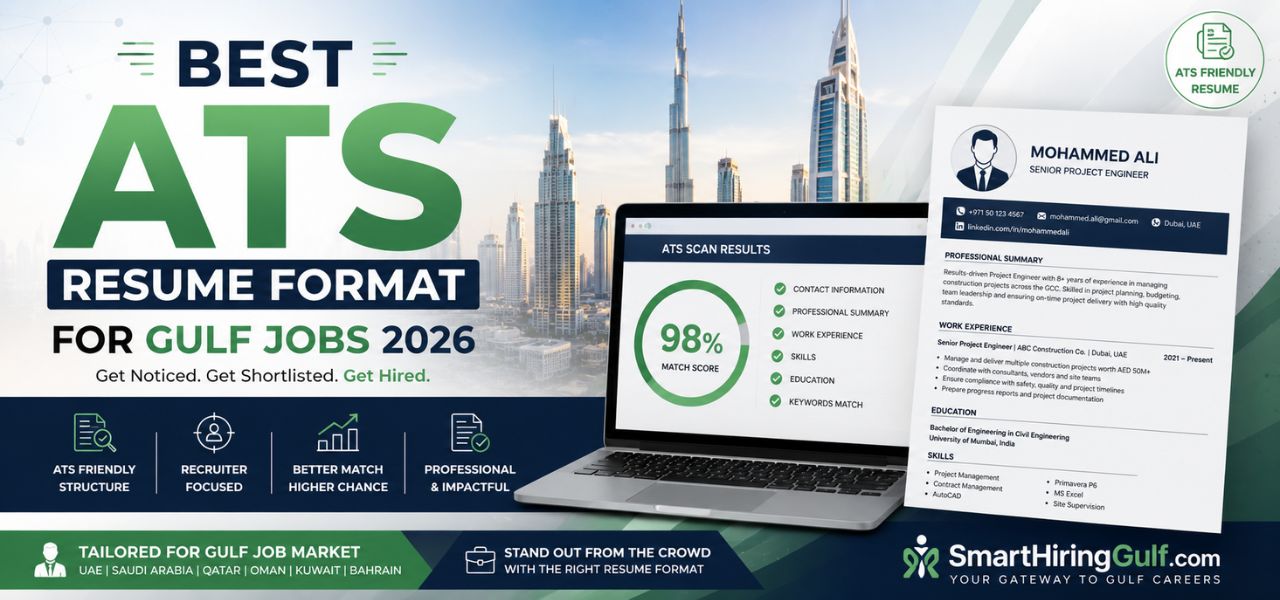
Many people send a Western‑style resume to Dubai or Riyadh and then hear nothing back. The issue is rarely weak experience. More often, the file ignores the best ATS resume format for Gulf jobs in 2026, even though there are proven, free template styles that make this easy.
Recruiters at Emirates Group, Emaar, and Al Futtaim rely on Applicant Tracking Systems (ATS) that expect Gulf‑style CVs. These tools scan for specific fields, layout choices, and keywords before a human ever opens the file. When my document looks like a US or UK resume, the system often filters it out as incomplete.
In this guide, I walk through how Gulf ATS software works, which mandatory fields my CV must show, how to format every section, and how to use ATS‑friendly templates. I also show how Smart Hiring Gulf fits into a smart search plan by connecting optimized candidates to regional employers.
Ready to turn that silent inbox into interviews across the GCC in 2026?
Key Takeaways
Before I move into the details, here is what I want you to remember. These points give a quick map of how to build an ATS‑friendly Gulf CV for 2026.
- Gulf ATS systems reject many Western resumes because they look incomplete to tools like Taleo, SAP SuccessFactors, and Zoho Recruit. When my CV hides visa status, nationality, or date of birth, the software cannot match me correctly. That means strong profiles never reach recruiters at Emirates Group or ADNOC.
- Western‑style resumes often miss key Gulf biodata fields that matter for visas, payroll, and housing packages. Without clear lines for nationality, marital status, and age, HR teams in Dubai or Riyadh may not be able to process my application. The ATS engine notices those gaps first and ranks me lower.
- Core ATS formatting rules for Gulf job applications cover file type, section order, headings, fonts, and document length. When I keep a clean Word (.docx) file with standard headings and simple bullets, Taleo and Sniperhire can read every line properly. That gives me a fair rank beside local candidates.
- Free ATS‑friendly templates plus good keyword habits help my CV pass screening on Bayt and Naukrigulf. By matching my wording to the job description and adding Gulf‑specific licenses or project names, I raise my score without stuffing phrases. Templates remove guesswork from layout choices.
- Smart Hiring Gulf adds a second layer of exposure once my resume is ready for 2026 standards. When I build a clear profile on Smart Hiring Gulf, employers in the UAE, Saudi Arabia, Qatar, Oman, Jordan, and Egypt can find me directly. That combination of ATS‑ready CV plus regional platform puts my search on much stronger ground.
Why Gulf ATS Systems Reject Western Resumes

Gulf ATS systems reject many Western resumes because they treat them as incomplete or poorly structured files. Applicant Tracking Systems in Dubai, Abu Dhabi, Doha, and Riyadh are tuned to Gulf hiring rules, not US or UK norms.
An ATS such as Taleo or SAP SuccessFactors scans every resume line and tries to place the text into boxes like visa status, nationality, experience, and education. According to Jobscan, about 99 percent of Fortune 500 companies use this type of software, and Gulf corporates follow the same pattern — a trend supported by recent research on Firm Data on AI adoption across large employers. When my file leaves out fields that local HR teams rely on, the system either ranks me very low or drops me completely.
“Most large organizations now rely on applicant tracking systems to manage incoming resumes efficiently.” — Society for Human Resource Management (SHRM)
The biggest conflict comes from anti‑discrimination habits in Western markets. In the US or Europe, I usually hide date of birth, marital status, nationality, and photo for legal reasons. In the GCC, employers at Etihad Airways, Dubai Mall retailers, or QatarEnergy often need those details for visa quotas, health cover, and housing allowances. Their ATS configuration marks those items as required inputs.
Format is the second problem. Western resumes sometimes use Canva designs, heavy graphics, or complex tables that look pretty on screen. Gulf ATS tools from Zoho Recruit or Sniperhire struggle with shapes, text boxes, and icons, so they read only part of the content — a vulnerability pattern documented in research on Navigating Software Vulnerabilities: Eighteen years of evidence from large U.S. organizations. When my job titles, dates, or skills fall inside those elements, the parser misses them and my match score drops.
On top of that, some candidates still submit only PDFs, or even image‑based PDFs, through portals such as Bayt or Naukrigulf. Those files can be very hard for older ATS engines to scan. Smart Hiring Gulf sees this pattern daily, which is why we push job seekers to rebuild their documents in simple, machine‑friendly formats first.
What Mandatory Gulf CV Fields Must You Include?

Mandatory Gulf CV fields cover visa status, nationality, date of birth, marital status, photo, and availability. If I skip these items, many Gulf ATS platforms treat my resume as incomplete before a recruiter opens it.
In the GCC, these data points are not viewed as optional add‑ons. They sit at the center of workforce planning for employers in the UAE, Saudi Arabia, Qatar, and Oman. A bank in Dubai or a hospital in Doha wants to know quickly if it can sponsor my visa, move my family, and slot me into age‑based insurance bands. According to Glassdoor, a single corporate vacancy can receive around 250 applications, so automation leans hard on such filters.
Here are the Gulf‑specific fields I always add to an ATS‑friendly CV:
- Visa and residency status gives Gulf recruiters an instant view of how soon I can join and what paperwork I need. I place this line directly under my phone and email, using simple text like Employment Visa – Transferable, Visit Visa – valid until 2026, or Golden Visa holder. Recruiters on Bayt and Naukrigulf often search for Visit Visa profiles first because these candidates can attend interviews and start work quickly.
- Personal biodata covers nationality, date of birth or age, and marital status, usually near the bottom under a Personal Details heading. Nationality helps HR teams manage Emiratization or Saudization quotas, and it also shapes salary bands in some sectors. Date of birth and marital status guide benefit design, such as whether the employer will budget family housing and school allowances in Dubai or Abu Dhabi.
- A professional headshot is still standard on Gulf CVs even though it is banned in many Western hiring systems. I use a passport‑style photo with a neutral light background and business clothing, then insert it neatly into the header area of my Word file. I avoid dragging the image across columns or layering shapes so ATS tools can still read the text around it cleanly.
- Availability and current location matter because distance affects start dates and cost. Right under my job title I add short text like Immediately Available, Notice Period – 30 days, or Based in Cairo – willing to relocate to Dubai. Recruiters often filter their ATS results for short‑notice candidates when they open a new branch or project.
When I add these fields in clear, label‑based text, Gulf ATS engines can route my profile correctly instead of sending it to a generic or rejected bucket.
How To Format Your Resume For Gulf ATS Compatibility

Formatting a Gulf resume for ATS compatibility means using a clean Word document with standard headings and simple layout rules. When I follow these rules, systems at Emirates NBD or Saudi Aramco read my history correctly and rank me fairly.
File type is my starting point:
- I use .docx (Microsoft Word) because it carries structured text.
- Unless a job ad on LinkedIn or a company site asks for PDF only, I submit .docx to keep parsing smooth.
- I avoid exporting fancy designs from graphic tools because they often convert text into images.
Layout comes next. I stick to a single column or a very simple two‑column file that keeps work experience in the main body. Fonts stay basic and ATS‑safe, such as Arial, Calibri, or Times New Roman at 10 to 12 points. I keep margins around one inch and leave enough white space so recruiters can skim on a laptop or phone.
Length also works a little differently in the Gulf:
- One full page for fresh graduates
- Two pages for mid‑career candidates
- Up to three pages for senior executives
Research shared by Ladders shows recruiters often spend around seven seconds on an initial scan, so my key skills, summary, and last role must sit on page one.
“Recruiters spend only a few seconds deciding whether a resume is worth a closer look.” — The Ladders
A short formatting checklist helps me keep everything ATS‑friendly:
- Use clear, standard headings. I keep sections in a logical order starting with Contact Information, then Professional Summary, Employment History, Skills, Education, Certifications, and Personal Details. Each heading uses normal text, not icons or creative labels, because ATS tools like Taleo search for familiar phrases. When the parser finds those headings, it can map content into the right boxes.
- Structure employment history consistently. In Employment History, I write job title, company name (such as Emaar or Qatar Airways), city, country, and dates on one neat line. Under each role I use simple round bullets and start with strong verbs, followed by numbers when possible. This style reads well for humans and avoids symbols that confuse ATS engines.
- Keep design simple and text‑based. I avoid text boxes, WordArt, logos, and graphic skill bars that show stars or progress lines. Instead, I list skills in a plain column and group them into areas such as software, languages, or technical skills. That way systems like Zoho Recruit and Sniperhire can scan every skill and match them to the job description.
As a final touch, I save the file name with clear keywords, such as Name‑JobTitle‑Gulf‑CV.docx, so recruiters and systems can find it later.
Gulf ATS Keyword Optimization Strategy
A Gulf ATS keyword strategy means matching my resume language closely to the wording inside each job ad. When I mirror that language, Applicant Tracking Systems in Dubai, Riyadh, and Doha score my CV higher against the target profile.
My simple process looks like this:
- Study the job post. I print or save the ad, then highlight key skills, tools, and certificates mentioned by the employer.
- List the core keywords. For a finance role at a bank in Abu Dhabi, that may include IFRS, VAT filing, and Oracle Financials. For a nurse role in Dubai, terms like DHA license, triage, and ICU experience matter.
- Replace vague wording. I swap weak phrases in my CV for specific, industry‑correct ones from the job ad.
- Repeat for every new role. I adjust my CV slightly for each application instead of sending one generic version.
Some phrases work better than others for ATS scanning. I try to replace vague wording with exact, search‑friendly phrases like the ones below.
| Weak Phrase | Better ATS Term |
|---|---|
| Leading projects | Project Management |
| Managing client interactions | Customer Relationship Management CRM |
| Handling finances | Budget Management |
| Improving website visibility | Search Engine Optimization SEO |
| Working with others | Team Collaboration |
I then weave these phrases into my Professional Summary and my bullet points under each role. For example, instead of saying “Improved online reach” I write:
Increased organic traffic by 40 percent through on‑page Search Engine Optimization (SEO) for a Qatar‑based retailer.
This feels natural to recruiters and hits the ATS target phrase at the same time.
For Gulf roles there is one more layer. I reference regional entities like ADNOC, Aramco, KHDA, DHA, HAAD, and free zones such as Jebel Ali when I have that exposure. These names act as strong keywords on their own, especially on portals like Bayt and Naukrigulf. According to SHRM, most hiring teams search their databases by skill and keyword first, then by company name, so those details matter.
Free ATS Resume Templates For Gulf Jobs And How Smart Hiring Gulf Helps

Free ATS resume templates for Gulf jobs give me a ready‑made structure that respects both regional fields and technical rules. When I start from a tested template, I can focus on content instead of guessing where to place visa status or which font to pick.
On Smart Hiring Gulf, I can follow region‑specific guidance on ATS‑ready layouts, biodata placement, and keyword choices that work well for employers across the GCC. That guidance sits alongside the tools offered by general template providers:
- Microsoft Word for the web offers several simple, ATS‑aware resume layouts that I can open and edit in my browser. I choose designs with clear section headings, no shapes, and no background images. After that, I add Gulf‑specific elements such as Visa Status and Personal Details in the header or footer area without changing the basic layout.
- Platforms like Resume.io provide ATS‑focused templates such as Simple ATS, Pure ATS, or Prime ATS that download as .docx. I still adapt each file to Gulf norms by adding nationality, date of birth, and a small space for a professional headshot. Before sending my CV to a role with Emirates Group or Qatar Airways, I upload the file to an ATS checker provided by builders like Resume.io to see if all sections parse correctly — a practice backed by findings in research on Automated ATS-Optimized Resume Builder systems with dynamic templates.
Smart Hiring Gulf then fits into my plan as the regional hub for my profile and applications. Our platform focuses on roles across the UAE, Saudi Arabia, Qatar, Oman, Jordan, and Egypt, so the structure we suggest mirrors what Gulf employers expect. When I complete my candidate profile on Smart Hiring Gulf, I can align my headline, skills, and work history with the same ATS‑friendly wording used in my resume.
Smart Hiring Gulf also offers premium resume and career document services built for the Middle East market. Our writers shape CVs that include Gulf biodata, regional keywords, and clean layouts that work with ATS tools like Taleo or SAP SuccessFactors. That support pairs well with the free templates from Microsoft Word or Resume.io and gives me a document ready for both large portals and direct employer inboxes.
The Bottom Line
The best ATS resume format for Gulf jobs in 2026 follows a simple rule set. I give Gulf employers the biodata they expect, keep my Word file clean and structured, and mirror the language in each job ad. When I do that, ATS engines in Dubai, Riyadh, Doha, and Muscat treat my CV as a strong match instead of an odd Western file.
Conclusion

To move forward, I start with an ATS‑safe template in .docx, then add visa status, nationality, date of birth, marital status, photo, and availability in clear text. I keep to one or two pages unless I hold a very senior role, and I lace my experience bullets with exact skills, licenses, and Gulf project names.
After checking the file with an ATS checker, I upload it to portals like Bayt and attach it to my Smart Hiring Gulf profile. That mix gives me far better odds of real interviews across the GCC in 2026.
Frequently Asked Questions
Question 1: Should I Include My Photo On A Resume For Gulf Jobs?
Yes, a passport‑style headshot is expected on most Gulf CVs. I use a clear, high‑quality photo with a neutral background and business clothing. I insert it neatly so it does not cover or break the surrounding text, which keeps ATS parsing smooth and looks professional to recruiters.
Question 2: Is A PDF Or Word File Better For Gulf ATS Systems?
A .docx Word file is the safest choice for Gulf ATS platforms. Many systems at large employers in the UAE and Saudi Arabia read Word far more accurately than PDFs. I only use a text‑based PDF when the job ad clearly asks for it as the sole format, and even then I keep a Word version for other applications.
Question 3: Do Gulf Employers Care About Resume Length?
Yes, Gulf employers care about resume length, but they allow more space than many Western markets. I keep my resume:
- To one page as a fresher
- To two pages as a mid‑career professional
- To three pages at most as a senior leader
The first page always holds my strongest information: summary, core skills, and most recent roles.
Question 4: What Is The Difference Between A Gulf CV And A Western Resume?
A Gulf CV usually includes personal biodata such as nationality, date of birth, marital status, visa status, and often a photo. A Western resume removes those items for legal reasons and often stays at one page. Gulf CVs can run to two or three pages when the role is senior and when the employer wants a full project list.
Question 5: Which ATS Software Do Gulf Employers Commonly Use?
Common ATS platforms in the Gulf include Taleo, SAP SuccessFactors, Zoho Recruit, and Sniperhire. Large groups like Emirates Group, Emaar, and major banks use these tools to filter high volumes of applicants. Each system prefers clean .docx files with standard headings and simple layouts, which is why formatting your Gulf CV carefully matters so much.